
When your hot tub refuses to power down, energy waste, component wear, and safety risks multiply. Resolving why a hot tub won’t turn off demands understanding pump circuits, heater controls, jets, control panel electronics, and electrical safeguards.
This guide equips San Diego County hot tub owners with immediate insights on diagnosing a continuously running pump, fixing a heater stuck on, correcting jets that won’t shut off, interpreting control panel errors, and addressing wiring or GFCI faults.
You’ll also find safe DIY reset steps and preventative maintenance strategies, along with when Action Spa Repair’s trained technicians should step in for expert service.
Key Takeaways
- A hot tub that won’t turn off usually indicates a control or electrical issue, often a stuck relay, damaged circuit board, or control panel glitch.
- Pumps or heaters that run continuously waste energy and wear down parts, leading to costly repairs later.
- Faulty relays and miswired GFCI breakers are common reasons spas stay powered even when turned “off.”
- Simple resets or cleaning filters can sometimes fix minor software or flow issues without tools.
- Error codes like F5, E2, or HL signal sensor or circuit problems that need specific diagnostics, not repeated resets.
- Action Spa Repair’s licensed technicians in San Diego use diagnostic tools to find the exact fault, ensuring reliable and long-lasting repairs.
Why Is My Hot Tub Pump Running Continuously?
A continuously running hot tub pump indicates that circulation control has failed at an electronic or mechanical level, causing nonstop water movement. Faulty relays on the circuit board often stick closed, delivering constant power to the pump motor.
Wiring faults such as shorted conductors can mimic a “run” signal, while control panel programming errors may override auto-off timers. Prolonged operation increases energy consumption by up to 30 percent and accelerates wear on impellers and seals.
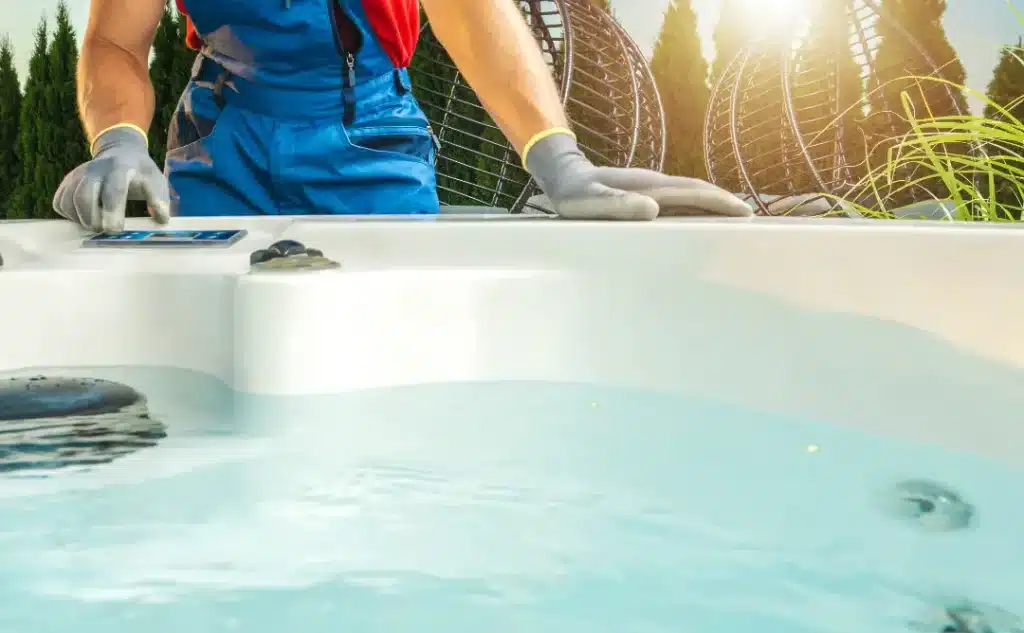
So, What Causes a Hot Tub Pump to Stay On?
If your hot tub pump won’t turn off, it usually means there’s a problem in the system. A stuck relay switch on the control board is a common issue. It doesn’t open the circuit, so the pump continues to run.
A damaged printed circuit board (PCB) can also send continuous voltage, keeping the motor on when it shouldn’t be.
Sometimes, miswired connections or poor installations can bypass control signals entirely. In other situations, a faulty temperature or flow sensor may wrongly detect heating or circulation problems.
This can cause the system to keep the pump running to protect the heater. Even airlocks or jammed impellers can mislead the safety circuits, leading to nonstop circulation.
Identifying the faulty component is crucial. Good diagnostics and precise repairs will solve the problem much better than repeatedly resetting the spa.
How to Diagnose a Stuck Pump Relay on Hot Tub Circuit Board
Start by turning off the power at the breaker for safety. Remove the spa pack cover and find the pump relay on the circuit board. Use a multimeter in continuity mode to test across the relay’s switch terminals:
- No continuity when “off” means the relay is working correctly.
- Continuity, even when “off,” indicates the contacts are stuck or welded closed.
Next, test the relay coil voltage while turning the pump on and off from the control panel. If the relay does not receive any signal change but is still powered, the PCB is likely faulty. If the voltage changes but the pump continues to run, the relay itself has failed.
This quick 20 to 30-minute test can confirm whether replacing the relay will fix the issue or if you need to repair or replace the entire circuit board.
Calling a licensed hot tub technician is essential for perfect and lasting solutions. Professionals bring diagnostic equipment to test control board logic levels, ensure GFCI integrity, and verify pump amp draw under load.
Action Spa Repair’s certified technicians maintain factory-calibrated settings and secure replacements to restore reliable pump operation.
How to Fix a Hot Tub Heater That Stays On
Three principal faults lead to an always-on heater: a defective temperature sensor providing incorrect data, a welded heater relay that cannot interrupt current, or a malfunctioning high-limit safety switch.
Corrosion around probe terminals can distort readings, while overheated relay contacts may fuse. Control panel firmware bugs occasionally disable automatic cutoff functions as well. Each of these issues causes the element to stay energized, risking water temperature exceeding safe limits.
Check and Reset the Hot Tub High-Limit Switch
Begin by powering down the spa breaker and locating the high-limit switch near the heater assembly. Press the reset button firmly until you feel a click, indicating the switch returned to its default open state.
Restore power and monitor the control panel for normal heating cycles. If the switch trips again quickly or fails to stay reset, underlying element faults or wiring shorts require professional inspection.
Consider Heater Relay Replacement
Heater relay replacement becomes necessary when continuity tests reveal a welded closed contact or when voltage readings remain present on output terminals after reset.
Symptoms include the heater running despite correct temperature readings and a lack of relay “click” during cycle changes.
Replacing the relay module with an OEM-approved part restores reliable switching and prevents continuous current flow through the heating element.
Common Reasons Your Hot Tub Jets Won’t Turn Off and How to Fix Them
Persistent jet operation points to control panel miscommunication or spa pack malfunction that maintains power to the jet pump.
Defective jet selector switches can send continuous “on” commands, while circuit board faults in the spa pack may deliver constant voltage to jet relays.
Hydraulic blockages rarely lock jets electrically, but they can trigger safety overrides that keep pumps active to clear airlocks. Restoring normal jet control prevents motor overheating and conserves energy.
1. Control Panel Malfunctions
When button contacts inside the control panel stick or the membrane overlay fails, the panel may register a permanent “on” command. Software glitches can lock relays in the active position until the firmware is reset.
Internal panel lights flashing error codes often accompany the issue, indicating a need for component-level servicing or panel replacement.
2. Faulty Circuit Boards
A spa pack circuit board with welded jet-relay contacts or damaged triac components will supply unbroken power to the jet pump. Inspecting relay contacts for pitting and measuring output voltage during off cycles confirms whether the board is at fault.
Board-level repair or a full module swap is required when relays cannot break the circuit under control panel commands.
How Hot Tub Control Panel Issues Cause Continuous Operation
Control panel malfunctions can disrupt communication between user inputs and the spa pack, causing components such as pumps or heaters to remain on. Software corruption can ignore “off” commands, while damaged ribbon cables fail to transmit key signals.
Overheating inside the panel housing may cause solder joints to crack, resulting in stuck inputs.
Correcting these malfunctions restores normal on/off cycles and prevents the activation of uncontrolled components.
Key issues include:
- wear on the membrane switch layers, causing false inputs
- water intrusion shorting circuit traces, and
- firmware errors that lock the interface.
Visible panel display glitches or error codes such as “F5” or “E2” often accompany these failures. Panel housing damage from UV exposure can accelerate the degradation of components. Recognizing these symptoms helps determine whether to opt for panel repair, firmware reload, or full module replacement.
How to Interpret Hot Tub Control Panel Error Codes?
Below is a comparison of frequent spa pack codes, their meanings, and recommended next steps.
| Error Code | Meaning | Recommended Action |
|---|---|---|
| F5 | Sensor open circuit | Inspect temperature probe wiring and terminals |
| E2 | Sensor short circuit | Replace the temperature sensor |
| HL | High-limit trip | Reset the high-limit switch and test the element |
| PUMP ERR | Pump circuit fault | Test relay output and continuity |
| LP | Low-pressure protection | Restore proper water flow and clean the filter |
Identifying the specific code links directly to targeted diagnostics and repair steps minimizes unnecessary component swaps.

Electrical Problems that Can Cause a Hot Tub to Stay On Continuously
Electrical faults in a hot tub frequently bypass control logic, keeping pumps or heaters energized. A tripped or miswired GFCI can lock the system into a fail-safe “on” state to prevent shock hazards. Shorted wiring in the junction box or faulty circuit breakers may backfeed current to backfeed into the spa pack.
Resolving these issues restores safe power cycling and protects both users and equipment.
GFCI Trip
When a ground fault circuit interrupter trips, it may not fully cut power if the contacts fuse, causing the spa pack to lose safety monitoring, yet still receive voltage. This partial trip state can leave components running despite user commands. Testing and replacing a GFCI device restores proper protection and ensures that on/off commands reach the spa pack reliably.
Wiring Issues
Damaged insulation or rodent-chewed conductors in supply lines can create unintended bridges between hot and neutral wires, energizing the spa pack constantly. Loose terminal screws at the breaker panel may cause backfeeding of current under load, while improperly sized breakers allow excessive current draw.
A licensed electrician should inspect and correct any wiring faults to meet the national electrical code and prevent fire risks.
Specialized spa electricians use insulation resistance testers, clamp-on ammeters, and thermal imaging to locate hidden faults without disturbing weatherproof junctions. Their expertise ensures that wiring and breaker sizing adhere to safety standards and that the spa pack receives clean, properly phased power.
Attempting electrical repairs without certification can void insurance and pose serious hazards.
What Are Safe DIY Troubleshooting Steps for a Hot Tub That Won’t Turn Off?
Homeowners can troubleshoot simple control or power issues before calling in technicians, provided they follow safety protocols. Always turn off the dedicated spa breaker before accessing control cabinets or testing circuits. Begin with visual checks for tripped breakers, clean filters, and low water levels that may trigger continuous operation modes. These basic actions often restore normal function without specialized tools.
Reset Your Hot Tub Breaker and Control Panel
Power down the spa breaker at the main electrical panel for at least one minute, allowing all control circuits to discharge. Return the breaker to the “on” position and observe the control panel’s startup sequence.
If the spa pack displays normal boot codes and cycles through filtration without immediate component activation, the reset corrected a temporary electronic hang. Persistent failures indicate a more serious issue that requires professional intervention.
Clean Filters and Check Water Levels
Dirty filters restrict flow, triggering low-pressure protection or high-limit trips that can lock pumps or heaters into continuous operation to prevent damage. Maintaining correct water levels ensures sensors operate within design parameters, avoiding false readings that can cause constant running.
Regular filter cleaning and water top-ups extend component life and prevent emergency shutdown modes.
When to Stop DIY and Call a Professional
If resets, filter cleaning, and water-level adjustments do not restore normal cycling within two attempts, further troubleshooting risks component damage. Complex failures such as welded relays, faulty temperature probes, or control board corrosion require technician-grade diagnostics.
Contacting Action Spa Repair at that point ensures a safe and efficient resolution, preserving the spa’s longevity.
Preventive Maintenance to Avoid Hot Tub Always-On Issues
Consistent maintenance prevents many causes of continuous operation by keeping sensors, relays, and water pathways operating within specifications. Routine filter cleaning, water chemistry balancing, and cover inspections reduce strain on pumps and eliminate flow interruptions.
A quarterly regimen of cartridge or pleated filter cleaning, weekly debris removal, monthly chemical balance checks, and annual spa pack inspections provides proactive protection.
These steps maintain optimal water flow, prevent corrosion on sensor probes, and keep relays and triacs in functional condition.
A well-executed maintenance plan can cut repair costs by up to 50 percent over five years.
How Proper Water Balance Affects Hot Tub Electrical Components
Balanced pH, alkalinity, and sanitizer levels prevent scale buildup and corrosion on metal probes and wiring terminals. Mineral deposits around temperature sensors distort readings and can force the heater into continuous operation.
Maintaining calcium hardness within recommended ranges ensures conductivity values remain stable, preserving control panel accuracy.
That’s a well-organized section. It’s clear, friendly for search engines, and customer-focused.
Frequently Asked Questions
Why won’t my hot tub turn off, even after I press the power button?
A stuck relay or faulty control panel button can keep the circuit energized. Even if the panel looks “off,” a damaged PCB can still send power to pumps or heaters, needing professional repair or replacement.
Can a tripped GFCI cause the hot tub to stay on?
Yes. A partially tripped or fused GFCI may not completely disconnect power. Testing or replacing the breaker ensures a safe and full shutdown.
Why is my pump running continuously when I’m not using the spa?
Continuous pump operation often indicates a faulty circulation relay, miswired connections, or control logic errors. Sensors that detect low flow or irregular temperature can also trigger nonstop circulation.
My heater won’t shut off. Is that dangerous?
Yes. A heater that stays on can overheat the water and damage insulation, seals, or plumbing. This often results from a faulty relay, a malfunctioning temperature sensor, or a failed high-limit switch and requires an immediate professional inspection.
What error codes mean my hot tub is stuck on?
Common indicators include:
- F5 – Open temperature sensor circuit
- E2 – Shorted sensor
- HL – High-limit trip
- PUMP ERR – Pump relay/output fault
- LP – Low-pressure mode active
Each code helps identify which component or system is failing.
When should I call a professional instead of resetting it myself?
If your spa keeps running after two resets or you notice electrical smells, tripped breakers, or error codes, stop troubleshooting immediately. These signs indicate deeper electrical problems that need professional help with your hot tub repairs in San Diego.
Conclusion
A spa that won’t shut off isn’t just an annoyance; it’s a warning sign of electrical problems that can raise energy costs and shorten your system’s lifespan. Finding and fixing the cause early, whether it’s a stuck relay, heater issue, or control board problem, ensures safe and efficient operation.
For reliable same-day hot tub repair in San Diego County, trust Action Spa Repair. Our licensed technicians diagnose and repair nonstop-running spas with warranty-backed repairs, custom parts, and on-site expertise you can depend on.
Call today to schedule a professional inspection and regain control of your hot tub quickly, safely, and affordably.